|
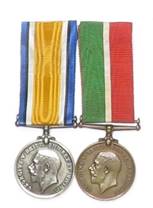
The British War Medal 1914-1920 and the Mercantile Marine Medal |
The
Great War 1914-1919 as
experienced by British Merchant Mariners, Fishermen and Naval Reservists - Historical
outlines and other information as background for research |
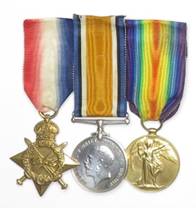
1914-15 Star, British War Medal 1914-1920 and the
Victory Medal |
|
To British people nowadays,
if considered at all, the first Great War of the twentieth-century is seen
generally not unnaturally as an incredibly blood-soaked struggle on the
Western Front in France and Belgium. Other theatres are also sometimes
remembered, primarily the disastrously ill-conceived campaigns in the
Dardanelles and on the Gallipoli Peninsula. Even then, aspects of these, such
as the contribution of aircraft, are hardly known of. There were also lesser
military campaigns that the British were involved in, Mesopotamia, Italy and
the Balkans for example that might occasionally be named by those with
a reasonable understanding. At sea the one and only clash of Great Britain’s
and Germany’s battlefleets at Jutland (or Skagerrak to the Germans) can be
recalled readily. If pushed, the exploits of German surface raiders in the
early months, or Germany’s unrestricted submarine campaigns to starve the
British Isles into surrender, are sometimes mentioned. But there was so
much more to the war at sea, especially as experienced by civilian mariners,
whether they remained in mercantile service or fishing, or, supported the
Royal Navy in a bewildering variety of tasks as reservists. Even
although in the past Great Britain’s mariners had also contributed similarly
in war, particularly through the almost incessant wars of the eighteenth and
early nineteenth centuries, through the long period of Pax Britannica
since 1815 there had been incredible technological changes in ships and weapons,
even if political attitudes
often remained much the same. Consequently, in August 1914 most
civilian mariners seem to have been under the misapprehension that the Royal
Navy’s fleets would be all the protection that they needed. After all, this
had been the official line from governments for decades.
The Royal Navy’s recruitment in war had traditionally been through
volunteers and when they were not to be found, forcibly in pressing,
primarily of merchant mariners and fishermen. By the middle of the nineteenth
century the latter form of recruitment was regarded as inefficient. So, the Royal Naval
Reserve was formed in the 1850s, but only for
a limited number of master mariners and seamen. In time, these were added to
considerably. Others, including amateur seamen, also wanted to serve in Great
Britain’s naval defence and eventually, the Royal Naval Volunteer Reserve came into
existence in 1904. The Great War as experienced by the
civilian mariners, whether in uniform, or not, has already been written on at
length in multi-volume official histories, as well as other studies. This,
therefore, is merely an attempt to outline relatively briefly the course of
the war and how it affected merchant mariners,
fishermen, naval
reservists and to a lesser degree, the German
submariners that they were linked inextricably to – without glorification. A note on the styles of the three
outlines mentioned above would not go amiss. Due to the sheer size of the
Mercantile Marine, it was not realistic to deal with merchant mariners’
wartime experiences in depth, mentioning the thousands of vessels by name,
never mind, the mariners themselves. Although the fishing sector was tiny in
comparison, it was still too large to deal with boat by boat. Nevertheless,
an impression of the struggles that the fishermen had both with British naval
authorities and German warships, surface and sub-surface, could be made. A
tendency already identifiable with mercantile tonnage and crews is even more
apparent with the fishing industry, whereby British naval authorities
regarded them all as never-ending sources of matériel and
manpower. As for the reservists, from
the very beginning they were used to fill gaps afloat and ashore and produce
increased capacity in all sorts of roles: planned, or otherwise. These
changed as the war progressed. Without denigrating others, those in the
Auxiliary Patrol in home waters had particularly difficult wars. Excepting, possibly,
the Admiralty-designed craft later in the conflict, none were designed for
continuous work, patrolling, minesweeping, or on other tasks, but this is
what they were required to do: in all seasons and weather conditions. The
role of minesweeping, by definition, was dangerous and in time it became
known that getting blown up, even in near misses, had deleterious effects on
mental health. Patrolling, had its own hazards, especially for those in
waters that required detailed knowledge and great navigational skill: such as
in the wilds of northern Scotland. Even before the fighting shifted inshore
and intensified greatly, operating in areas known to be bounded by minefields
and at night, with no, or reduced navigational aids and steaming lights,
there was already an increased possibility of collisions. This rose
exponentially in the last few years, with small-craft being struck and sunk
by their own brethren, other larger Allied warships and also merchantmen: and
the survivors, not infrequently, were left to fend for themselves. Of course,
there were also German warships, submarines and aircraft (fixed-wing and
airship) to contend with. So, this is reflected in a far longer and
detailed outline for the reservists’ war. Even then, long lists of
small-craft sunk and reservists killed is only one facet of their part in the
Great War at sea.
Although there were many different variations in these attacks,
the sheer number makes repetition in writing unavoidable. Therefore, reading
the three main pages in totality may not be to the tastes of all.
Similarly, writing fully on the German submariners that sought
to cut the western Allies’ seaborne lines of communication would be a
daunting task. Nevertheless, sketches have been produced on seven commanders,
with the aim of assessing their characters as individuals. Even in this tiny
sample, differences can be determined, especially in the way that they
treated the crews of the merchantmen, Allied and neutral, as well as the
fishing-craft that they encountered. Incidentally, there is also a fair
amount of information on many sinkings in these sketches, showing how
varied they could be. These sketches are of differing lengths, especially for
those that were war criminals that are far longer.
Finally, the information on the campaign medals and various badges is
also not aimed at glorifying war. While many wore their medals proudly, even
if only on Armistice Day annually, others did not and left theirs
untouched. Since British Great War campaign medals were named (unlike in the
Second World War), through research it is possible to gain impressions of
recipients’ service, if not their personalities that remain, overwhelmingly,
illusive. |
||
|
While I am now semi-retired and
concentrate on my own studies on the Great War at sea, I remain available to
conduct research on a freelance basis, not only on operational aspects, but
also on mariners that served before, during and after this conflict. As
before, I can still be contacted on e-mail using len@barnettmaritime.co.uk. |
||
|
|
||
|
|
||