Medals
|
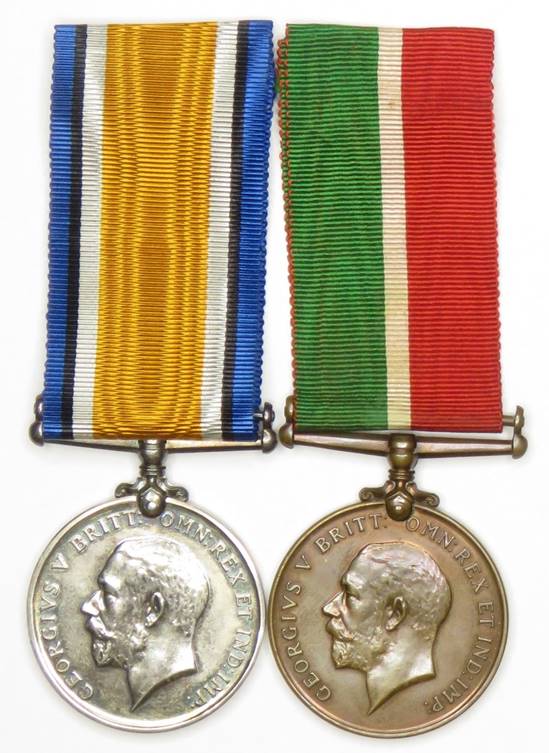
Recipient – Henry (Harry) Warner – Wireless
Operator |
The British War Medal 1914-1920 and the Mercantile Marine War
Medal These are the two medals generally awarded
to British merchant mariners and those of the Empire, fishermen and all sorts
of other civilians involved in coastal maritime work that had been active
during the Great War. Those that also served partly in naval service, or in
the Mercantile Marine Reserve were also entitled to the Victory Medal. While the ribbons on this pair would appear to be the original silk
ones as issued, there are indicators that they were never worn. The
recipient’s medal card entries show that the ribbons were issued at the
Mercantile Marine Office in Salford, Manchester, in March 1920. Unusually,
the actual medals were authorised through the Board of Trade offices in
London, in August 1922 though. Also, these came into my possession with the
original little paper envelopes that such medals were issued
in. |
|
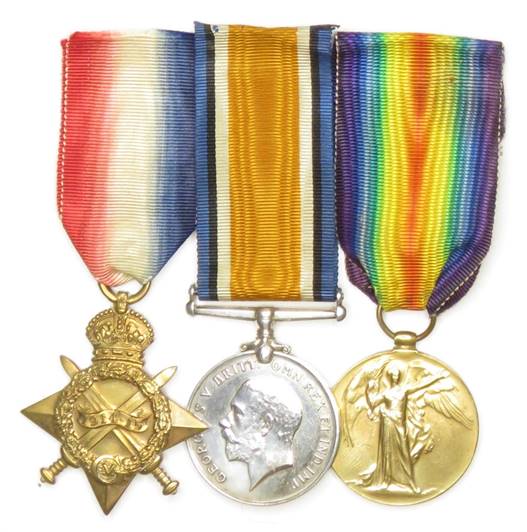
The 1914-15 Star, British War Medal 1914-1920
and the Victory Medal This is a typical group of medals
awarded to naval reservists that became involved relatively early in the war
– as can be seen by the 1914-15 Star. Those that had been on active service
in the first months of the conflict were, instead, awarded the 1914 Star that
was similar, but not identical. Obviously, those that only served during the
last three years received the British War Medal and the Victory Medal only. Once again, all these ribbons are silk.
While the one for the victory medal is damaged, it does not look as if it has
ever been mounted on a bar. However,
the other two seem to have been cut from a bar. Incidentally,
modern replacement ribbons look and feel differently from silk
ones. |
Recipient – Frederick Walter Killett
– 2nd-Hand R.N.R. |
|
Recipient - Skipper Basil Robert George
R.N.R. |
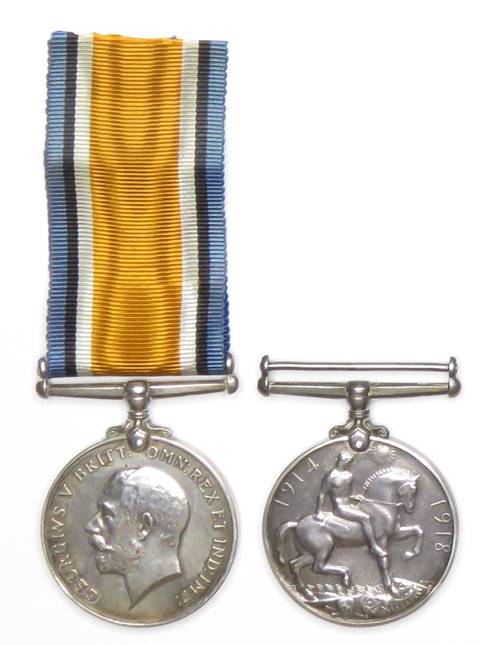
British War Medal 1914-1920 Instituted in
July 1919, the British War Medal was awarded widely to those in British and
Imperial Forces (Dominion, Colonial and Indian), including the Mercantile Marine, fishermen and numerous
other classes of mariners working in coastal waters. Originally, proof of
six months service between 4th August 1914 and 11th November 1918 was
required. However, with continuing hazardous operations in mine-clearance and
the various interventions in the Baltic and Russia, the qualification period
was extended to 1920. There had been an intention to issue these with clasps,
but so many were suggested that this element was abandoned.
Nevertheless, the naval clasps were authorised in July 1920 and consequently,
these can be found on miniatures sometimes.
The observe shows a left-facing profile of King George V, while the
reverse depicts a mounted Saint George trampling on the eagle shield of the
Central Powers and a skull and crossbones. As far can be determined, all
issued to mariners were in silver.
Also, in the Great War British campaign medals were named. Official
numbers, names and ranks, or rates were inscribed on the rim for those in
armed forces. Names only were inscribed for civilians, such as merchant mariners and fishermen. |
|
Mercantile Marine War Medal Also instituted in July 1919, entitlement to the Mercantile Marine War
Medal was also open to those in Dominion, Colonial and Indian service.
Additionally, proof of having been crew of a merchantman on at least one
voyage through one of the danger zones was needed. Of note, those, both male
and female whose service at sea had been curtailed through capture, or
disablement, were deemed as having qualified for one, or both of these
medals. Harbour service did not count though.
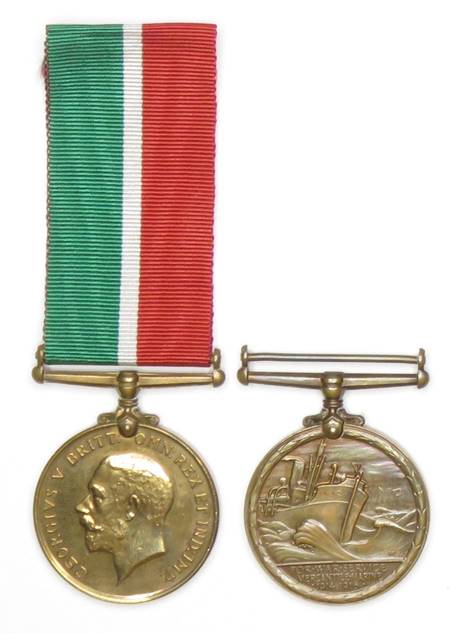
Produced in bronze, as with the British War Medal 1914-1920 the
obverse has a left-facing profile of King George V, with the reverse
primarily showing a rather strange steamer navigating a heavy sea, surrounded
by a laurel wreath. On the horizon is a fore-and-aft rigged sailing-vessel,
with what is supposed to be a sinking U-boat, but the latter would be
unrecognisable without being pointed out!
Also, in the Great War British campaign medals were named. Recipients’
names were inscribed on the rim. |
Recipient - Frank Mayor – 1st Mate |
|
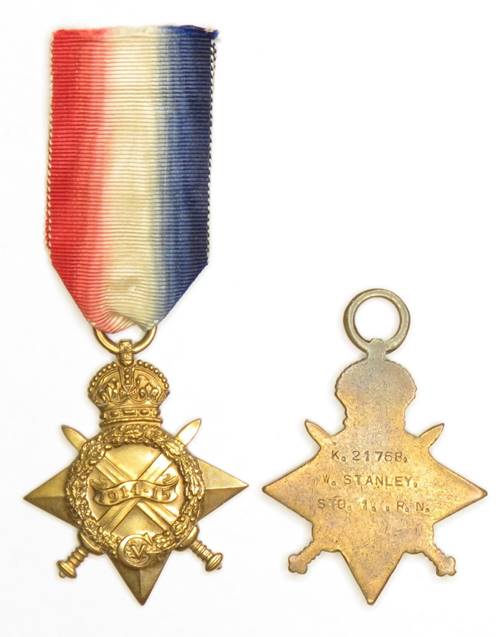
Recipient of the medal showing the reverse -
William Stanley – Stoker 1st-class R.N. |
1914-15 Star
The 1914 Star had been approved in 1917, with that the 1914-15 Star in
the following year. The naval forces
that they were awarded to were those of the R.N., R.M., R.N.A.S., R.N.R.,
R.N.V.R., R.I.M., Dominion Naval Forces and also those of the Mercantile
Marine that were serving under naval engagements (such as on T124 forms) that
were active at sea, or in theatre variously in 1914 and 1915.
Struck in bronze, the design of the 1914-15 Star was slightly less
fussy than the 1914 Star. The obverse of both were based on a crowned
four-pointed star, with crossed swords and laurel wreath. Within these were
scrolls, with the relevant dates in 1914, or years 1914-15.
In the Great War British campaign medals were named. Official numbers,
names and ranks, or rates were normally inscribed on the rim, but in the case
of these stars they were on the reverse. |
|
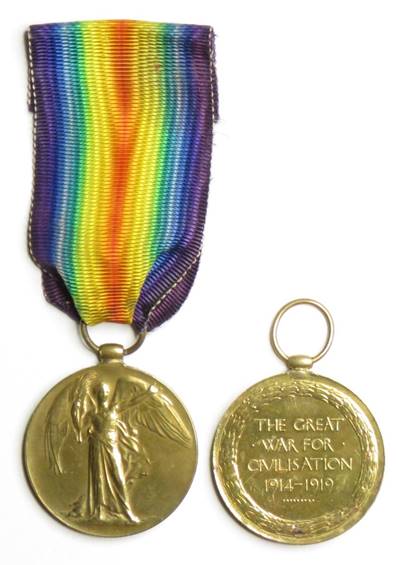
Victory Medal This was one form of medals that were
awarded internationally by the Allies with a common ribbon, but different
design for each nation. Instituted in 1919 the British one was issued to all
already entitled to either the 1914 or 1914-15 Star and the British
War Medal and to most that were entitled to the British War Medal.
Those in the Mercantile Marine that were serving under naval engagements
(such as on T124 forms) were also entitled. In yellow bronze, the obverse shows the
winged figure of Victory full-length holding a palm-branch in her right hand
and with her left arm held out. On British medals the obverse was inscribed
with ‘THE GREAT WAR FOR CIVILISATION 1914-1919’ surrounded by a
laurel-wreath. Also, in the Great War British campaign
medals were named. Official numbers, names and ranks, or rates were inscribed
on the rim for those in armed forces. Names only were inscribed for
civilians, such as merchant mariners and fishermen. |
Recipient – Edward Horace Waygood – Able
Seaman R.N.V.R. |
|
|
|